
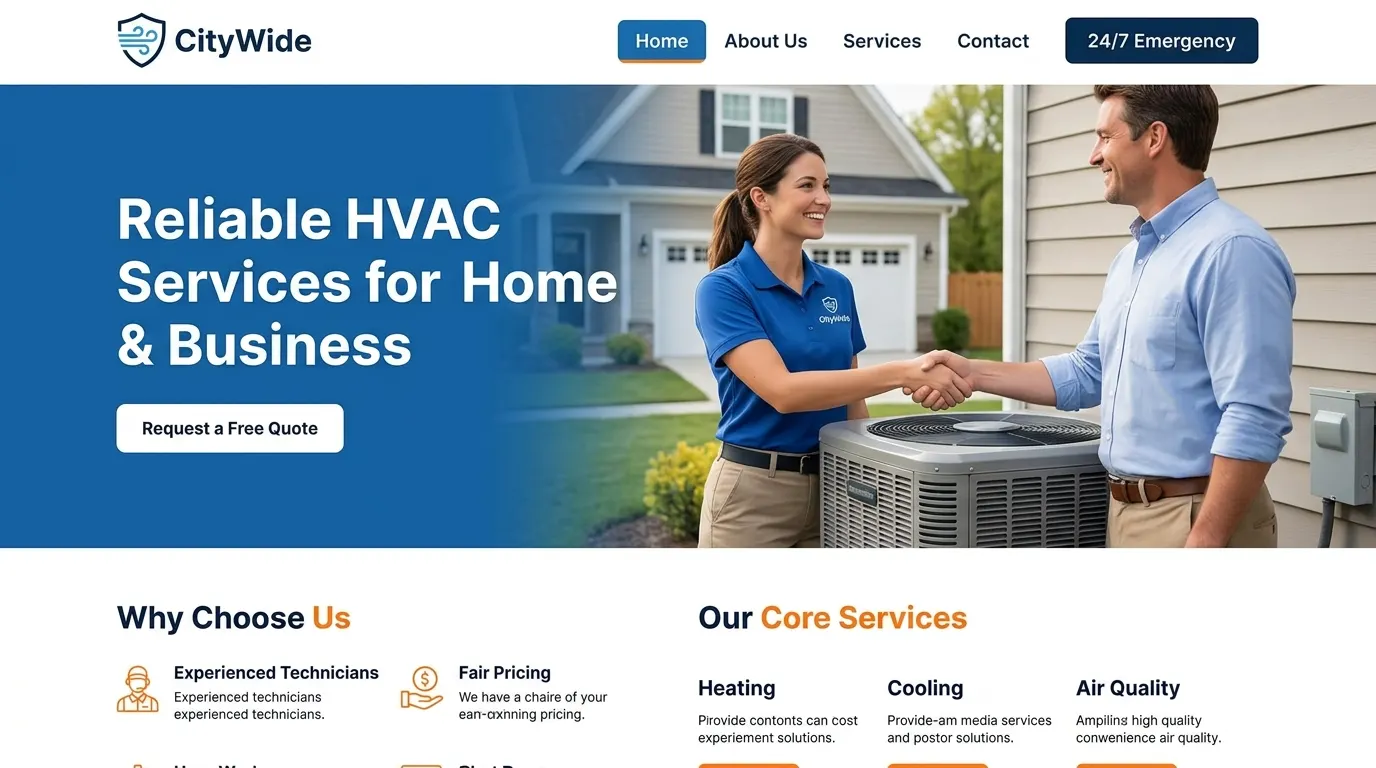
Your HVAC website is either booking service calls or sending homeowners straight to a competitor. And in this trade, the stakes are temperature. A broken AC in July. A dead furnace in January. The person searching is already uncomfortable, already stressed, and ready to call whoever looks like the safest bet.
HVAC is different from other home service trades. The search patterns are seasonal. The equipment is expensive. The decision often involves thousands of dollars and the comfort of a whole household. A site built for a plumber or a roofer won't work the same way for an HVAC contractor.
This guide covers what actually makes an HVAC website generate calls. Written for contractors, not designers.
Why generic websites fail HVAC contractors
Most web designers build one kind of site and call it done. Looks fine. Loads okay. Has a phone number somewhere. For an HVAC contractor, that's not enough.
Your customers search in two completely different modes, often switching between them in the same year.
The emergency customer. AC stopped blowing cold in August. Furnace won't light in January. This person is on a phone, uncomfortable, and willing to pay a premium for someone who can show up today. They need to see your number immediately, confirm you serve their area, and know you're available now.
The planned customer. Replacing a 15-year-old system. Adding a heat pump. Installing ductless mini-splits. This person is comparing brands, efficiency ratings, and prices. They'll visit multiple sites before calling. They want to see your certifications, your past installations, your financing options, and your pricing structure.
A single HVAC website has to serve both. Most don't. They optimize for emergencies and lose the planned customer, or they go heavy on information and bury the phone number. Either way, calls leak.
Seasonal content is not optional
HVAC is the most seasonal trade in home services. What a homeowner searches for in July is completely different from what they search for in December. If your website doesn't reflect that, you're invisible half the year.
Cooling season runs April through September. AC repair, AC installation, ductless mini-split installation, and refrigerant recharge are the searches that spike. Your site needs dedicated pages for each of these — not a single "AC services" page that tries to cover everything.
Heating season runs October through March. Furnace repair, furnace replacement, heat pump installation, and boiler service dominate. Separate pages for each, with seasonally relevant content and keywords.
Shoulder seasons are for maintenance. Spring tune-ups, fall furnace inspections, and indoor air quality. These are the pages that fill your calendar during slower months and prevent emergency calls from piling up during peak season.
A blog that publishes seasonal maintenance tips, energy efficiency guides, and "when to repair vs replace" content keeps your site fresh and signals to Google that you're active in both seasons. HVAC companies that publish seasonal content consistently outrank those that don't.
Most HVAC websites are built once and never touched again. They rank for neither heating nor cooling searches because they try to rank for both on a single page. Separate content for separate seasons is the single biggest ranking opportunity most HVAC contractors ignore.
The phone number problem is worse for HVAC
Every home service website needs a visible phone number. For HVAC, the stakes are higher because so many searches are time-sensitive. A homeowner with a dead AC in 95-degree heat is not going to hunt for your number.
Your phone number needs to be visible on every page, at every screen size, without scrolling. A sticky header on desktop. A sticky bottom bar on mobile with a tap-to-call button. Not hidden behind a hamburger menu. Not buried in the footer. Front and center, always.
The emergency call button needs its own treatment. High-contrast color. Text that says "Emergency Service Available" or "24/7 Service." Links directly to your phone — no forms, no menus, no friction. When someone needs emergency HVAC service, every second they spend navigating your site is a second they could be calling a competitor.
HVAC customers need different trust signals
HVAC equipment is expensive. A new furnace or AC system can run $4,000 to $12,000 or more. Homeowners don't make that decision lightly. Before they call, they scan for reasons to trust you.
Five things every HVAC site needs visible near the top.
License and insurance. State HVAC license number, liability insurance, worker's comp. Answers the basic "is this contractor legit?" question before they have to ask.
NATE certification. North American Technician Excellence certification is the industry standard. Displaying it tells homeowners your technicians are tested and qualified, not just warm bodies in a truck.
Brand affiliations. Carrier, Trane, Lennox, Rheem, Goodman — if you're an authorized dealer or certified installer for any major brand, say so. It signals that manufacturers trust you, which helps homeowners trust you.
Real reviews with service details. Google reviews that mention specific installations or repairs. "They installed our new Trane system in one day" is more convincing than "great company."
Financing information. HVAC replacements are often unexpected expenses. Showing that you offer financing — and roughly what terms are available — removes a major barrier to calling.
These five signals need to be visible above the fold on your homepage. A homeowner deciding whether to call won't dig through your site looking for proof. If they don't see it in the first few seconds, they move to the next name on the list.
Separate service pages for separate problems
One of the most common mistakes on home service websites is lumping everything into a single services page. AC repair, furnace replacement, duct cleaning, indoor air quality — all in one big list. That page can't rank for all of those searches.
Someone searching for "AC repair near me" wants a page that talks about AC repair. Someone searching for "furnace replacement cost" wants a page that talks about furnace replacement. One page can't serve both.
Each major service needs its own page. A cooling services page that covers AC repair, AC installation, and ductless mini-splits. A heating services page that covers furnace repair, furnace replacement, and heat pump installation. A maintenance page for tune-ups and inspections. An indoor air quality page for purifiers, humidifiers, and ventilation. An emergency HVAC page that leads with the phone number.
Each page is built around the specific problem that person is searching for and includes the keywords, content, and calls to action that match that search. For most HVAC contractors, that means 12 to 18 pages covering the services that actually generate revenue. Each one is a separate opportunity to show up in Google when someone needs exactly what you offer.
Emergency calls and scheduled replacements are two different businesses
A no-cooling call in July at 6 PM and a furnace replacement someone is researching on a Sunday afternoon are not the same customer. Your site needs to handle both without confusing either.
Emergency visitors want one thing. Your phone number. Confirmation you're available. Nothing else. No explanations of your process. No requests to fill out a form. No long paragraphs about company history. Call now.
Scheduled replacement visitors want information. Pricing. Efficiency ratings. Brand comparisons. Before-and-after installation photos. Financing terms. Testimonials from similar jobs. They're patient but skeptical. They need to be convinced you're the right choice for a major investment.
Keep these paths separate. Emergency messaging should be loud, unmistakable, and persistent across every page. A red or orange banner at the top. A sticky call button. Language like "Available Now" not "Call for a Quote." Scheduled service pages can take their time with information, comparisons, and trust building.
When you treat both the same, you frustrate emergency callers with too much information and rush scheduled shoppers who need more convincing. Separate the paths and both groups convert better.
Maintenance plans are your most profitable page
Most HVAC websites focus on repairs and replacements. Those are high-ticket, but they're unpredictable. Maintenance plans are predictable recurring revenue. And they need their own page.
A dedicated maintenance plan page that explains what's included — bi-annual tune-ups, priority service, discounted repairs — and lets customers sign up online. No phone call required. Pick a plan, enter your info, and you're on the schedule.
HVAC companies with online maintenance plan signups fill their slow season calendars, smooth out revenue, and build a customer base that calls them first when something breaks. It's one of the highest-ROI pages an HVAC site can have, and most contractors don't build one.
How your website and Google Maps work together
Google Maps is where most local HVAC searches start. Your Google Business Profile determines whether you show up in the map pack when someone searches for AC repair or furnace replacement in your area.
Your profile needs the right primary category — HVAC Contractor — plus relevant secondary categories like Air Conditioning Repair, Furnace Repair, Heat Pump Installation, and Ductless Mini-Split Installation. Accurate hours that reflect your actual service availability. A service area that covers every city you work in. Photos updated regularly, especially of recent installations.
Your website's role is to close the deal after the profile gets the click. It needs to back up the trust signals from your profile and give the homeowner the deeper information that turns a looker into a caller. Consistent NAP — name, address, phone — across both is critical. Any inconsistency confuses Google and hurts your ranking.
Profile gets you found. Website gets you hired. You need both working together.
The speed problem
HVAC websites tend to be slow. High-resolution photos of installations, video content, heavy page builders, cheap hosting. All of it adds up to a site that takes four, five, six seconds to load on a phone.
When that happens, visitors leave before the page finishes. They never see your phone number. They never read your NATE certification. They never get a chance to call. They're just gone — and likely calling a competitor whose site loaded faster.
Google also notices. Slow sites get pushed down in search results. Fewer people find you in the first place.
The fix isn't complicated. Use clean, lightweight code instead of a bloated page builder. Compress images. Use hosting built for speed. These choices determine whether your site loads fast enough to keep visitors who are already uncomfortable and impatient.
Frequently asked questions
How much does an HVAC website cost in 2026?
Anywhere from $16 a month for a DIY builder to $15,000 for a custom agency build. Most single-location HVAC contractors do well with a professionally built site between $997 and $2,500 that includes local SEO, schema markup, click-to-call, service area pages, and separate heating and cooling service pages. Avoid subscription models charging $300 to $800 a month. Over three years that's $10,800 to $28,800 and you own nothing.
Should I have separate pages for heating and cooling?
Yes. Someone searching for AC repair in July has a completely different problem than someone searching for furnace replacement in November. Separate pages let you target seasonal keywords, create relevant content, and give each customer exactly the information they need. A combined HVAC page ranks for neither search well.
How many pages does an HVAC website need?
At minimum: a homepage, individual pages for cooling services, individual pages for heating services, an emergency HVAC page, a maintenance plan page, service area pages for every city you cover, and a contact page with click-to-call. Most HVAC contractors need 12 to 18 pages to compete in local search.
How do I get my HVAC website to show up on Google?
Three things. An optimized Google Business Profile with the right categories and service areas. Individual service pages targeting specific seasonal keywords like "AC repair in your city" and "furnace replacement in your city." Consistent positive reviews from customers. Most HVAC contractors start seeing results within 60 to 90 days if these are in place.
Do HVAC websites need seasonal content?
Yes. HVAC is the most seasonal trade. A site that publishes spring tune-up guides, summer AC maintenance checklists, and winter heating preparation tips captures search traffic when customers are actively looking for each service. Seasonal content is one of the highest-ROI things you can add to your site.
What is the most important feature for an HVAC contractor website?
A prominent, always-visible emergency call button. HVAC emergencies happen at night, on weekends, and during extreme weather. A sticky phone header and emergency banner on every page — visible on mobile without scrolling — is the single highest-impact feature for HVAC websites.
How long does it take to build an HVAC website?
Forty-eight hours to 12 weeks depending on who builds it. Template services launch in 2 to 4 weeks. Custom agencies take 4 to 12 weeks. Some providers like Ideal Media Pro launch in 48 to 72 hours with custom design, local SEO, schema markup, and separate heating and cooling pages included.
Can I build my own HVAC website?
You can. Wix and Squarespace run $16 to $49 a month. The trade-off is time and technical know-how. DIY sites usually don't include proper local SEO, schema markup, separate seasonal service pages, or conversion-optimized layouts. Most HVAC contractors who go the DIY route end up hiring a professional within a year.
Getting an HVAC website that actually generates calls
You don't need a $15,000 home services website. You need a site that loads fast on a phone, makes your number impossible to miss, shows homeowners why they can trust you, has dedicated pages for heating and cooling services, and captures seasonal search traffic. That's not a premium feature. That's the baseline for getting calls in 2026.
Agencies charging $5,000 to $15,000 aren't delivering five times the value. They're charging for overhead, account managers, and sales commissions. Subscription services at $379 a month are worse — you pay forever and own nothing.
For a complete breakdown of what every home service business needs from a website in 2026, start with The Honest Guide to Web Design for Home Service Businesses. Then come back here for the HVAC-specific details that matter most to your trade.
The right move for most HVAC companies is a professionally built site at a fair one-time price. Everything that actually generates calls included as standard. Ideal Media Pro's home service web design package was built around that. $997 one-time. Full ownership. Launch in 48 to 72 hours. Local SEO, schema markup, click-to-call, and dedicated seasonal service pages built in from day one.
Get an HVAC Website That Generates Calls
$997 one-time. Full ownership. Launch in 48–72 hours. No subscriptions, no hidden fees, no contracts.
View the $997 Home Service Package