
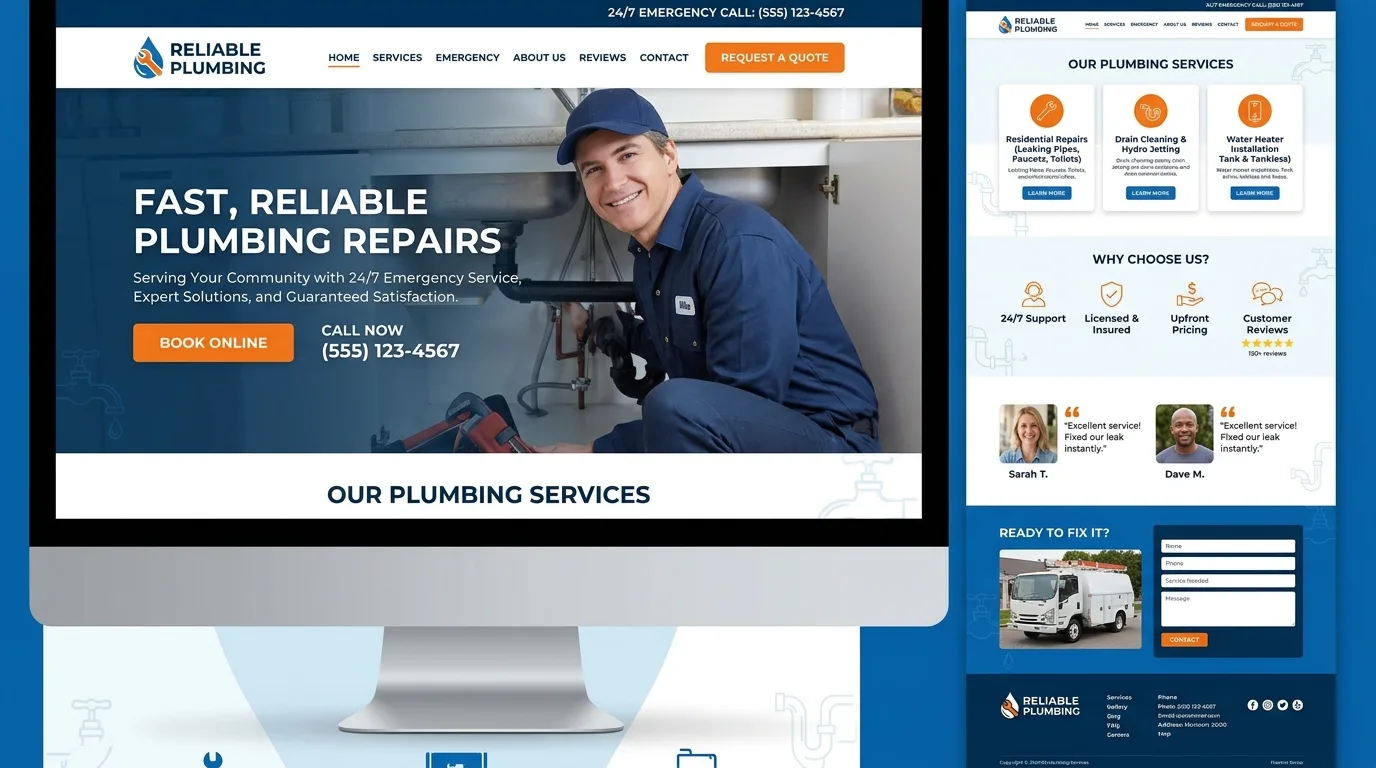
Your plumbing website is either booking jobs or sending callers straight to your competitors. Most plumbers don't realize this until they've paid for a site, waited weeks, and watched the phone stay silent. The work is good. The site just isn't doing its job.
Plumbing is different. When someone searches for a plumber, they're usually standing in water, staring at a broken water heater, or watching a toilet overflow. They're not browsing. They're not bookmarking for later. They need someone in the next few minutes, and they'll call whichever business looks like the safest bet in that moment.
A site built for a restaurant or a law firm won't work for a plumber. Different stakes. Different timeline. This guide covers what actually makes a plumbing website generate calls. Written for you, not for designers.
Why most plumbing websites don't get calls
The person who built your site probably designed it on a desktop computer and called it done. Looks great on a big screen. Falls apart where it matters.
Picture this. It's 10 PM. A homeowner hears water running somewhere it shouldn't. They grab their phone, search "plumber near me," and land on your site. Three seconds later they're gone if they can't tell whether you serve their area, whether you're available, and how to reach you.
Three seconds. That's the window. Not three minutes.
A site that buries the phone number, loads slow on mobile, or doesn't name the cities you serve is losing jobs it should be winning. Simple as that.
The phone number has to be impossible to miss
Sounds obvious. But it's the most common problem on plumbing websites. The number is too small, hidden behind a hamburger menu, or it's plain text you can't tap to call.
Most plumbing searches happen on a phone. Your number needs to be visible the second someone lands on your site. Not after they scroll past the hero shot and the welcome message. Right there.
A sticky call button that follows the visitor as they scroll? That single change drives more calls than any other design decision on the site.
And it has to be clickable. Not a phone number someone has to memorize and type into their dialer while standing in a flooded basement. One tap. That's it. Anything else is a barrier, and they'll move to the next listing that makes it easy.
What homeowners scan for before they call
Plumbers deal with a trust problem. You're asking a stranger to let you into their house, often at night, often when they're already stressed. Before they call, they look for reasons to trust you.
Four things. Every time.
License and insurance. A license number on the site, proof of insurance, years in business. Answers the question "is this person legit?" before they have to ask.
Real reviews. Not testimonials you wrote yourself. Google reviews with real names, real dates, specific service details. A review that says "they showed up at 11 PM and fixed my water heater" is worth more than anything you can say about yourself.
Proof you work in their area. Name the towns. Be specific. "We serve the greater metro area" doesn't tell anyone anything. "We serve Arlington, Mansfield, and Grand Prairie" tells a homeowner you actually come to their neighborhood.
Real photos. Your actual trucks. Your actual team. Actual jobs you've completed. Stock photos of a guy in a blue uniform holding a wrench are easy to spot and they hurt trust rather than build it.
These four things need to be visible near the top of your homepage. A homeowner deciding who to call in an emergency won't dig around your site looking for proof. If it's not right there, they're calling the next name on the list.
Why one services page won't cut it
Lots of home services websites cram everything into one services page. Drain cleaning, water heaters, leak detection, sewer work. All in a single bullet list. Big mistake.
Someone searching for "drain cleaning near me" has a different problem than someone searching for "water heater replacement cost." One page can't serve both. It can't rank for both.
Each major service needs its own page. A drain cleaning page that talks about drain cleaning. A water heater page that talks about water heaters. An emergency plumbing page that leads with the phone number. Each one built around the specific problem that person is searching for.
This isn't about padding your site with content. It's about making sure a homeowner who has a backed-up sewer line lands on a page that says "we fix backed-up sewer lines" and tells them exactly what to do next. Not a page where they have to dig through five unrelated services to figure out if you can help.
For most home service businesses, that means 8 to 15 pages covering the services that actually generate revenue. Sounds like a lot. But each page is a separate opportunity to show up in Google when someone needs exactly what you offer.
Emergency calls and scheduled work are not the same thing
A burst pipe at midnight and a water heater replacement you're researching on Saturday morning are two completely different situations. Your site needs to handle both.
Emergency visitors want one thing. The phone number. Right now. With confirmation that you're available. No forms. No process explanations. No "fill out this quote request." Call now.
Scheduled work visitors want information. Pricing. Reviews. Examples of your work. They're patient but skeptical. They need to be convinced.
Keep these paths separate. Emergency messaging should be loud and unmistakable. A banner across the top of every page. A sticky call button. Language that says "available now" not "call for a quote." Scheduled service pages can take their time with process, pricing, and trust building.
When you treat both the same, emergency callers get frustrated by too much information and scheduled shoppers feel pushed. Separate them and both groups convert better.
How your website and Google Maps work together
Lot of plumbers think a website alone gets them found on Google. Doesn't work that way. Google Maps is where most local plumbing searches start. And your spot there depends on your Google Business Profile, not your website.
Your profile is what shows up in the map pack when someone searches for a plumber. It needs the right categories (Plumber as primary, plus Drain Cleaning, Water Heater Installation, Emergency Plumber as secondary). Accurate hours. A service area that covers every city you work in. Photos updated regularly.
Your website plays a different role. It's where the homeowner goes after they see your profile to decide whether to call you. It needs to back up the trust signals from your profile and give them the deeper information that turns a looker into a caller.
Profile gets you found. Website gets you hired. You need both. One without the other means you're either invisible or can't close the deal once someone finds you.
That's why your site needs to match your Google Business Profile exactly. Same business name. Same phone number. Same address. Any inconsistency confuses Google and hurts your ranking.
The speed problem nobody talks about
Most plumbing websites are slow. Page builders, giant photo files, cheap hosting, too many plugins. All of it adds up to a site that takes four, five, six seconds to load on a phone.
When that happens, visitors leave before the page finishes. They never see your number. They never read your reviews. They never get a chance to decide whether to call. They're just gone.
And Google notices. Slow sites get pushed down in search results. Fewer people find you in the first place.
The fix isn't complicated. Build with clean code instead of a bloated page builder. Compress images so they load fast. Use hosting that's actually built for speed. These choices make a real difference in whether your site loads fast enough to keep visitors.
Speed matters more for plumbers than for most businesses because the people searching are already in a hurry. A site that loads in two seconds keeps them. A site that takes five seconds loses them to whoever loaded faster.
Frequently asked questions
How much does a plumber website cost in 2026?
Anywhere from $16 a month for a DIY builder to $15,000 for a custom agency build. Most single-truck operations do well with a professionally built site between $997 and $2,500 that includes local SEO, schema markup, click-to-call, and service area pages. Stay away from subscription models charging $300 to $800 a month. Over three years that's $10,800 to $28,800 and you own nothing.
Can I build my own plumbing website?
You can. Wix and Squarespace run $16 to $49 a month. The tradeoff is time and technical know-how. DIY sites usually don't include proper local SEO, schema markup, fast mobile load times, or layouts designed to convert. Most plumbers who go the DIY route end up hiring a professional within a year anyway.
How many pages does a plumber website need?
At minimum: a homepage, individual pages for each major service (drain cleaning, water heater repair, emergency plumbing, leak detection, sewer line repair), a service area page listing every city you serve, and a contact page with click-to-call. Most plumbing businesses need 8 to 15 pages to compete in local search.
How do I get my plumbing website to show up on Google?
Three things. A fully optimized Google Business Profile with complete categories, photos, and service areas. Individual service pages that target specific keywords like "drain cleaning in your city." Consistent positive reviews from customers. Most plumbers start seeing results within 60 to 90 days if these three are in place.
Do I need separate pages for each city I serve?
Yes. If you serve 10 cities, you need 10 separate service area pages with unique content for each one. Google ranks individual city pages. A generic "we serve everywhere" page gets ignored. Each page should mention local landmarks, specific neighborhoods, and include reviews from customers in that area.
How long does it take to build a plumbing website?
Forty-eight hours to 12 weeks depending on who builds it. Template services launch in 2 to 4 weeks. Custom agencies take 4 to 12 weeks. Some providers like Ideal Media Pro launch in 48 to 72 hours with custom design, local SEO, and schema markup included.
Getting a plumbing website that actually works
You don't need a $15,000 home services website. You need a site that loads fast on a phone, makes your number impossible to miss, shows homeowners why they can trust you, and has dedicated pages for the services people actually search for. That's not a premium feature. That's the baseline for getting calls in 2026.
Agencies charging $5,000 to $15,000 aren't delivering five times the value. They're charging for overhead, account managers, and sales commissions that have nothing to do with whether your phone rings. Subscription services at $379 a month are worse. You pay forever and own nothing.
The right move for most plumbing companies is a professionally built site at a fair one-time price. Everything that actually generates calls included as standard, not sold as upgrades. Ideal Media Pro's home service web design package was built around exactly that. $997 one-time. Full ownership. Launch in 48 to 72 hours. Local SEO, schema markup, click-to-call, and service area pages built in from day one.
Get a Plumbing Website That Actually Generates Calls
$997 one-time. Full ownership. Launch in 48–72 hours. No subscriptions, no hidden fees, no contracts.
View the $997 Home Service Package